We’re proud to announce that Help a Child will play a crucial role in the implementation of a new, ambitious programme in Rwanda aimed at creating better opportunities for young children.
The goal of this programme, which is granted by the Education Outcomes Fund (EOF), is to improve the quality of Early Childhood Education (ECE) across 130 ECD-centres, reaching 25,000 children in 390 community-based centres in the coming three years. It is more than just a project; it’s a commitment to inclusive, high-quality education for every child, regardless of ability or background.

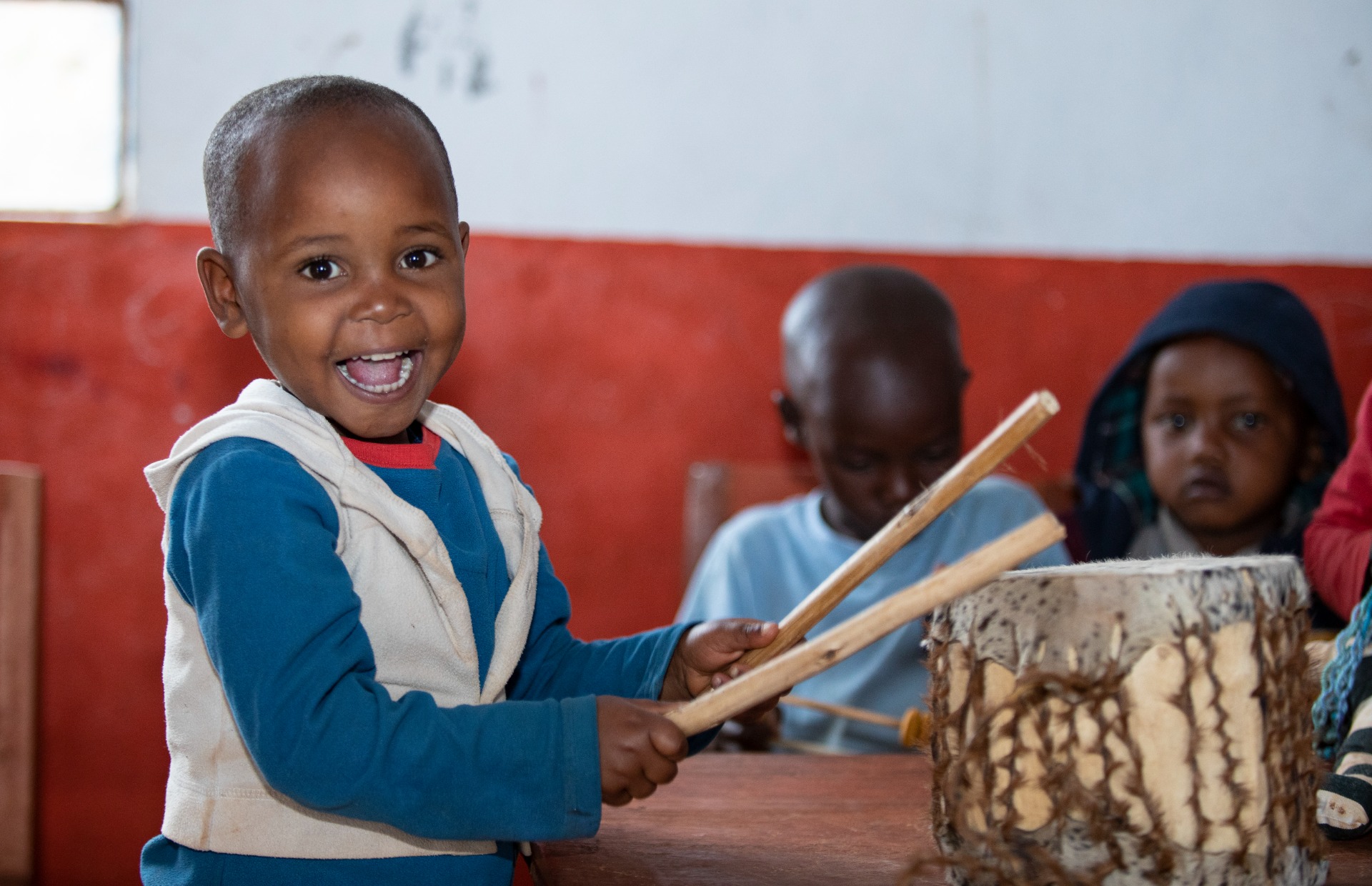
Help a Child Rwanda strongly supports the Rwandan government’s priorities in enhancing access to quality Early Childhood Development (ECD) services for children and families. Recognizing the need to increase ECD access, Help a Child plays a key role in reinforcing ECD services as vital community spaces by training ECD caregivers.
Considering the limited capacity of both parents and caregivers to deliver quality ECD services, Help a Child Rwanda focuses on equipping ECD caregivers with the skills and knowledge to provide high-quality services. A core element of the training is ensuring that ECD teachers and caregivers are empowered to maintain ECD environments that are playful, safe, and clean, fostering an ideal learning atmosphere for children.
589 trained ECD teachers
In 2024, Help a Child Rwanda successfully trained 589 ECD teachers. The training emphasized playful learning, inclusive teaching practices, and care methodologies. It also aligned these approaches with Rwanda’s ECD curriculum, ensuring a more cohesive and effective teaching strategy. The training was noteworthy for its collaboration between ECD teachers and the parents of the children they serve. This partnership was enriched by the involvement of parents in ECD activities, including toymaking, creating a holistic approach to early childhood education that benefits both children and families.


Through this initiative, Help a Child Rwanda continues to build sustainable, high-quality ECD practices, supporting the development of both teachers and the children in their care.
In a pioneering move aimed at transforming the lives of vulnerable children in Rwanda, Help a Child launches Turakura Kids Rwanda.
This innovative program is designed to enhance early childhood development for children aged 0-7, focusing on providing quality education and creating safe environments. Help a Child is the first child-sponsoring organization to take this innovative step towards community work with a focus on children.
The name Turakura means ‘We grow and learn together’ in the Kinyarwanda language, and this reflects Rwanda’s strong communal culture and highlights the program’s emphasis on collective growth.

A brighter future for Rwanda’s children
With Turakura Kids Rwanda, Help a Child wants to make a lasting impact on Early Childhood Development for 25,000 children in the coming five years. With its focus on community empowerment, quality education, and child protection, the program aligns with Rwanda’s national priorities and the global goal of improving access to education for every child. “By ensuring that children are at the heart of development efforts, we are providing a future for children in need, their family and their entire community”, says Jean Claude Nshimiyimana, Country Director of Help a Child Rwanda.
“Turakura Kids Rwanda is about empowering communities to create sustainable solutions that benefit their children today and in the future”
Key features of Turakura Kids Rwanda:
- Community-centric approach – Turakura Kids Rwanda is rooted in the belief that sustainable change begins at the community level. The program encourages local participation in planning, decision-making, and implementation, ensuring that the needs of the children and their families are met in a way that is sustainable and that the needs of children are met after the project concludes. By bringing communities together, Turakura strengthens social cohesion and collective responsibility for children’s welfare. We also aim at increasing household income, allowing parents to be better able to take care of their kids.
- Focus on Early Childhood Education – A critical aspect of the program is its focus on early childhood education, addressing the significant gaps in educational access for children under seven in Rwanda. To ensure that children have the opportunity to thrive, Turakura plans to construct six preschool facilities annually, totalling 30 over the next five years. These schools will provide quality education and safe spaces for young children to learn and grow.
- Enhanced Child Protection – In addition to education, Turakura Kids Rwanda emphasizes child protection, safeguarding vulnerable children in its programs. By promoting collective responsibility and reducing individual child sponsorship, the program ensures that children are protected from exploitation and receive care in a secure environment.
- Digital engagement for supporters – The Turakura model is not only new for Help a Child but also a new model for sponsoring in The Netherlands. Turakura moves away from traditional child sponsorship models by offering a digital platform that allows supporters to receive direct updates from children in the program through videos, newsletters and quarterly updates. This immersive experience provides a deeper connection between supporters and the communities they support, making the experience more personal and impactful.

We want every child to have a live in dignity, with love and a promising future. With the start of this new five-year programme, we can empower the next generation and create a better, more sustainable future for more children in need. To read more on this programma, click here.
Since January 2024, Help a Child is certified against the Core Humanitarian Standard! We passed the rigorous scrutiny by the independent certification body HQAI – Humanitarian Quality Assurance Initiative. Our certification objectively demonstrates that we comply with the requirements of the CHS. It means that we put affected children and populations at the center of our programmes, include their feedback and opinion in our work and create programmes based on the needs of people. Geert de Jonge, Manager Expertise and Development, tells more about our certification journey during an interview conducted by HQAI.
Why did you decide to go from independently verified to certified?
“The most important pillar of our strategic plan is achieving more quality and impact. Our reason of existence is providing a future for children in need. We do our utmost to accomplish this and quality is our driving force. To aim for certification shows the world that we take our commitment seriously. Being part of a select group of professional organizations that meet this highest standard, motivates us to continue to live up to this ambition. The yearly maintenance audit of certification gives us an extra external drive to make it a continuous priority.”
Can you tell us more about your HQAI certification journey?
“We started our CHS journey in 2019 with our first self-assessment and we repeated this in 2022. Both of these self-assessments have resulted in improvement plans for the organization, pushing us to develop more effective and quality aid. In 2023 we have done the external audit and the reflections of the auditors have helped us to further grow. Looking back at this journey, we really improved in quality in for example Community Based Feedback, Knowledge Management, Disaster Risk Reduction, Partnership Management and communication with communities.”
What were the challenges you encountered?
“The investment of time and resources of the external audit were challenging, but outweighs the benefits of identifying sharp and critical ways of improvement. As a relatively small NGO the CHS pushed us far, but also opened up new avenues for further funding by larger donors enabling us to provide more impact for more children in need.”
What specific improvements have you seen?
“Community Based Feedback: in 2019 this was a completely new topic for us. We have always invited the communities to share their feedback, but now we have been able to setup a clear mechanism for channelling this feedback and responding to that feedback. This is a very visible improvement at Help a Child, from policy level to field level.
Knowledge Management: we realized in 2018 during a synthesis evaluation of all our projects that just creating high quality policy documents is not enough. It is really all about how to ensure we reach the hearts and minds of our field staff so that they understand and live by our philosophy. We introduced all kinds of trainings, information exchange, e-learnings and started with Knowledge Management as an important pillar in our organization.
Disaster Risk Reduction: up to 2019, we were organized in silos: one silo for development programmes and one silo for Disaster Response. Triple Nexus as an important discourse came up in our sector and also CHS pushed us to really connect development with Disaster Response. This resulted in more attention for Disaster Risk Reduction in our development programmes and more sustainability and empowerment approaches in Disaster Response.
Partnership Management: with the support of CHS we have been able to improve on equal partner relationship, and becoming more transparent in the relationship with our implementing partners. Our multi-annual contracts changed accordingly and we have further invested in the relationship with our implementing partners.
Communication with communities: during the external audit in 2023, we realized we need to improve on the intensity and quality of our communication to our beneficiaries, explaining who Help a Child is as the donor behind our implementing partners and about what integrity means to us. In the following years we want to further improve quality on this topic.”
What was your experience of collaborating with the HQAI auditors?
“The auditors were incisive and analytically proficient, directing our organization to the right points and ensuring that this did not feel like a paper audit but really contributed to clear areas of improvement at policy and field level. We appreciated their support and their push to further improve our quality.”
What are the expectations from donors now that you will be CHS certified? Do you think they will change?
“We expect more and more donors to adopt the CHS standard and by doing so increase the level of CHS compliance. For us, CHS is the highest quality standard and by adhering to it we see possibilities to further diversify our donor portfolio adhering to the highest compliance requests.”
In summary, what impact has the certification had on your work?
“The process to achieve certification has been very helpful. We now have a clearer understanding of where systems, policies and practices are strong and effective, and where further improvement is needed. The detailed incisive audit report has helped us to improve. The entire process was an excellent opportunity to put the CHS at the forefront in the entire organization and realign our activities and procedures accordingly. The CHS motivates us to walk the extra mile when it comes to meeting the highest quality standards.”
[button_primary link=”https://www.hqai.org/en/news/Dutch_Relief_Alliance_Help_a_Child_Tearfund_Netherlands-Interview/”]Read the shared interview with Tearfund and the Dutch Relief Alliance[/button_primary]
