We’re proud to announce that Help a Child will play a crucial role in the implementation of a new, ambitious programme in Rwanda aimed at creating better opportunities for young children.
The goal of this programme, which is granted by the Education Outcomes Fund (EOF), is to improve the quality of Early Childhood Education (ECE) across 130 ECD-centres, reaching 25,000 children in 390 community-based centres in the coming three years. It is more than just a project; it’s a commitment to inclusive, high-quality education for every child, regardless of ability or background.

Help a Child Rwanda strongly supports the Rwandan government’s priorities in enhancing access to quality Early Childhood Development (ECD) services for children and families. Recognizing the need to increase ECD access, Help a Child plays a key role in reinforcing ECD services as vital community spaces by training ECD caregivers.
Considering the limited capacity of both parents and caregivers to deliver quality ECD services, Help a Child Rwanda focuses on equipping ECD caregivers with the skills and knowledge to provide high-quality services. A core element of the training is ensuring that ECD teachers and caregivers are empowered to maintain ECD environments that are playful, safe, and clean, fostering an ideal learning atmosphere for children.
589 trained ECD teachers
In 2024, Help a Child Rwanda successfully trained 589 ECD teachers. The training emphasized playful learning, inclusive teaching practices, and care methodologies. It also aligned these approaches with Rwanda’s ECD curriculum, ensuring a more cohesive and effective teaching strategy. The training was noteworthy for its collaboration between ECD teachers and the parents of the children they serve. This partnership was enriched by the involvement of parents in ECD activities, including toymaking, creating a holistic approach to early childhood education that benefits both children and families.


Through this initiative, Help a Child Rwanda continues to build sustainable, high-quality ECD practices, supporting the development of both teachers and the children in their care.
In a pioneering move aimed at transforming the lives of vulnerable children in Rwanda, Help a Child launches Turakura Kids Rwanda.
This innovative program is designed to enhance early childhood development for children aged 0-7, focusing on providing quality education and creating safe environments. Help a Child is the first child-sponsoring organization to take this innovative step towards community work with a focus on children.
The name Turakura means ‘We grow and learn together’ in the Kinyarwanda language, and this reflects Rwanda’s strong communal culture and highlights the program’s emphasis on collective growth.

A brighter future for Rwanda’s children
With Turakura Kids Rwanda, Help a Child wants to make a lasting impact on Early Childhood Development for 25,000 children in the coming five years. With its focus on community empowerment, quality education, and child protection, the program aligns with Rwanda’s national priorities and the global goal of improving access to education for every child. “By ensuring that children are at the heart of development efforts, we are providing a future for children in need, their family and their entire community”, says Jean Claude Nshimiyimana, Country Director of Help a Child Rwanda.
“Turakura Kids Rwanda is about empowering communities to create sustainable solutions that benefit their children today and in the future”
Key features of Turakura Kids Rwanda:
- Community-centric approach – Turakura Kids Rwanda is rooted in the belief that sustainable change begins at the community level. The program encourages local participation in planning, decision-making, and implementation, ensuring that the needs of the children and their families are met in a way that is sustainable and that the needs of children are met after the project concludes. By bringing communities together, Turakura strengthens social cohesion and collective responsibility for children’s welfare. We also aim at increasing household income, allowing parents to be better able to take care of their kids.
- Focus on Early Childhood Education – A critical aspect of the program is its focus on early childhood education, addressing the significant gaps in educational access for children under seven in Rwanda. To ensure that children have the opportunity to thrive, Turakura plans to construct six preschool facilities annually, totalling 30 over the next five years. These schools will provide quality education and safe spaces for young children to learn and grow.
- Enhanced Child Protection – In addition to education, Turakura Kids Rwanda emphasizes child protection, safeguarding vulnerable children in its programs. By promoting collective responsibility and reducing individual child sponsorship, the program ensures that children are protected from exploitation and receive care in a secure environment.
- Digital engagement for supporters – The Turakura model is not only new for Help a Child but also a new model for sponsoring in The Netherlands. Turakura moves away from traditional child sponsorship models by offering a digital platform that allows supporters to receive direct updates from children in the program through videos, newsletters and quarterly updates. This immersive experience provides a deeper connection between supporters and the communities they support, making the experience more personal and impactful.

We want every child to have a live in dignity, with love and a promising future. With the start of this new five-year programme, we can empower the next generation and create a better, more sustainable future for more children in need. To read more on this programma, click here.
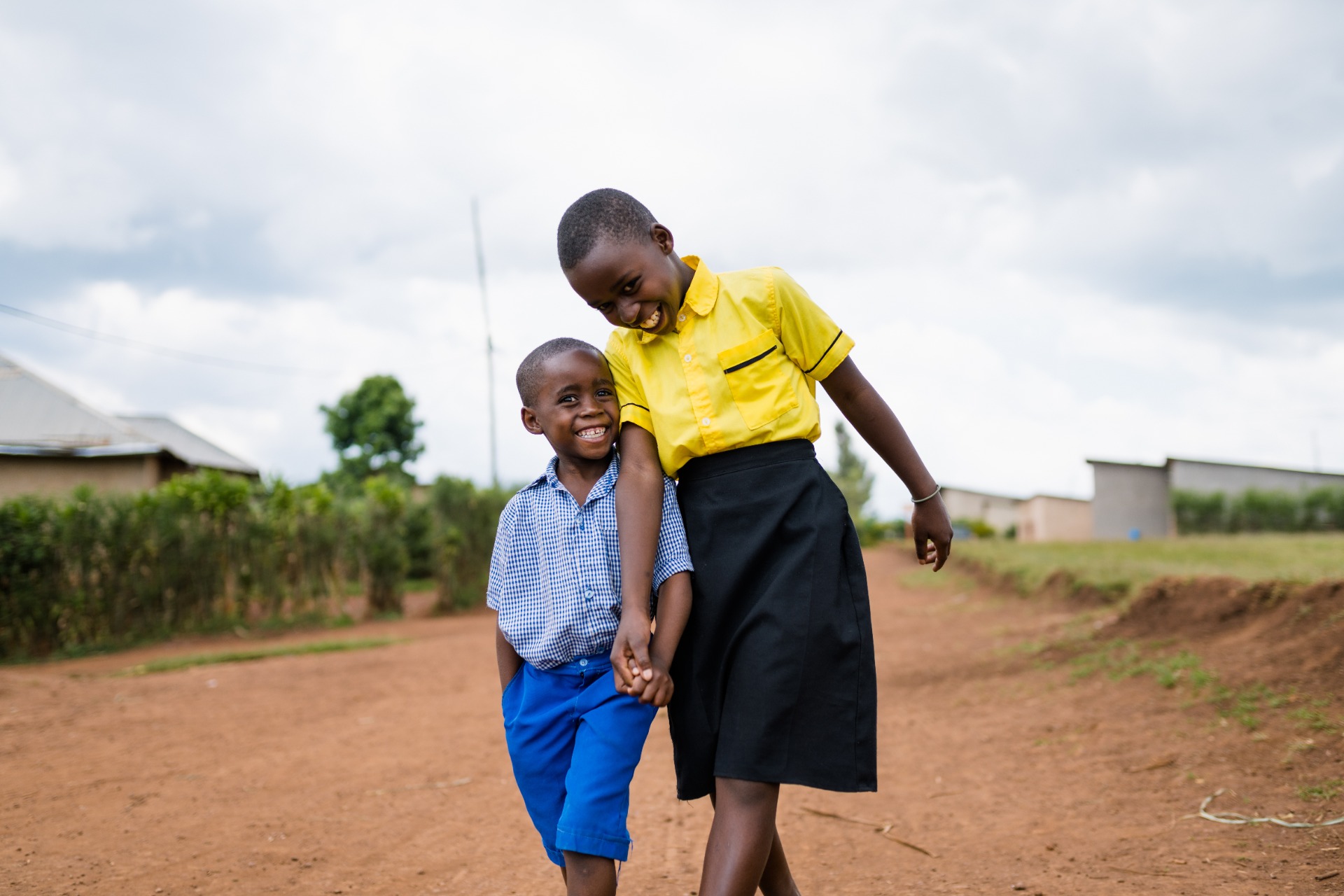
Liliane (11 years old) is one of the children in our programs. She lives with her parents and younger brother in Rwanda.
Liliane goes to school every day. She wants to become a doctor later, and her brother Fabrice wants to become a pilot. But this is not just the story of an eleven-year-old girl. Previously, there was no breakfast, no decent housing, and not enough money for a school uniform and textbooks. Fabrice stayed home because there was no preschool or kindergarten. “My primary school was far away,” Liliane says. “I had to walk three hours every day. It made my legs hurt. Most of the time, I hadn’t had breakfast, and I was often late for school.”
“I had to walk three hours every day. It made my legs hurt.”
Solane, Liliane’s mother, explains: “All the hard work we did on the land was not enough to meet our basic needs. And everyone in our community was in the same boat: not enough food for the children, not enough money for school… We had nowhere to turn, we were completely on our own. I didn’t know what else I could do to change our situation.”
Self-Help Group
Help a Child wants to break the vicious circle of poverty with village programs. Parents come together in Self-Help Groups (SHGs) to work on solutions. “The SHG has been our salvation,” says Solane. She has been a member of the group for three years now, and it has brought her a lot: “The most important thing is that we join forces. We save money together and because of that, I can borrow money to invest. All the small amounts of money we bring together make such a big difference. Before I didn’t know how to deal with problems, now I think in possibilities.”
A radiant family
Step by step, the residents of the area are breaking the poverty they live in. And it has an effect on the children! Liliane notices the difference: “Dad and mom can easily buy a school uniform and textbooks for me.” The local government saw the success of the preschool/kindergarten that came through the program and decided to build an elementary school. Liliane says: “Before, I used to come home very late and then I still had to do homework. Then it was difficult to get up very early the next morning to walk to school again. Now it’s nearby.” What a radiant family they are now!

Hope
There are still things the family struggles with, like the lack of water, but life is completely different for Liliane. Her parents see a way out of deep poverty, the total hopelessness has disappeared. That hope is the most important change of all. Mother Solane concludes: “I want my children to grow up healthy and finish their education. My dream is that they will go far!” Thanks to the village program of Help a Child, there is new perspective for Liliane, Fabrice, and their family. We believe that a child is only truly helped when the whole family is doing better. And poverty in families can only be overcome when an entire community changes along.